Why AI Must Be Built Into the Heart of Real Estate Networks
10-11-20268 minJulien Tabore · President of MaFormationImmo
Julien Tabore, President of MaFormationImmo, met Inoveo3D at the RENT 2026 trade show. In this guest column, he explains why artificial intelligence is only worth as much as its accessibility and the training that comes with it — before handing over, to close, to Arnaud Convers, founder of Inoveo3D, who answers five questions.
Key Takeaways
Julien Tabore (President of MaFormationImmo) and Arnaud Convers (founder of Inoveo3D) met at RENT 2026 and share one conviction: technology is only worth as much as its accessibility and the training behind it.
Inoveo3D offers a white-label approach: its AI tools integrate directly into a real estate network's own platform, under its name and branding.
MaFormationImmo follows a similar logic with its white-label training Campuses — both discuss a possible partnership between training and technology tools.
Inoveo3D is launching its 2D-to-3D Floor Plan tool on 13 November 2026, turning a simple floor plan into a furnished, configurable, downloadable 3D model.
Introduction
Artificial intelligence is transforming our real estate professions. But I'm convinced the real revolution won't come solely from the tools themselves: it will come from our ability to fit them into professionals' daily routines and to train people to use them.
That's precisely what caught my interest when I met Inoveo3D at the RENT 2026 trade show.
Talking with Arnaud, I discovered an approach that echoes a conviction I've held for several years at MaFormationImmo: new technology has to be simple, accessible, and genuinely useful to professionals in the field.
Real estate doesn't need yet another piece of software
Today, real estate agents already use a long list of tools: transaction software, CRMs, listing-distribution platforms, photography solutions, communication tools, management apps and training platforms.
Artificial intelligence applications are now adding to that list.
So the question is no longer just which technologies exist. It's mainly about understanding how to make them accessible without making professionals' daily work even more complicated.
That's why I find Inoveo3D's strategy interesting.
The company develops AI home staging, photo retouching, video creation, virtual tours and property-showcasing solutions.
But above all, it offers real estate networks a white-label approach, letting them integrate these features directly into their own platforms.
Inoveo3D's tools integrated into a network's platform (example with a fictional brand).
In other words, the agent could access advanced technology without constantly having to step outside their usual work environment.
To me, that's a particularly sound direction.
White-label is about to become a strategic issue for networks
At MaFormationImmo, we know this logic well, since we also build white-label training Campuses for real estate networks.
Our goal is to let a company offer its staff a genuine training environment built in its own image, with its identity, its learning paths and its tracking tools.
I see a fairly similar philosophy in Inoveo3D's approach.
Inoveo3D white-label: the tools inside the network's platform, in its own colours.
Why force a real estate network to pile up separate subscriptions and standalone platforms, when it can integrate directly the services its staff actually need?
Integrating these solutions then becomes a point of differentiation.
Tomorrow, a network could bring together its transaction tools, its communication solutions, its AI features and its training paths within a single environment.
I see that as a particularly promising development.
AI home staging: a concrete example of changing practices
Let's take a simple example.
An agent wins a listing for an empty apartment, or one that needs work before it can be presented well.
Traditionally, they would have had to organise a physical staging, hire outside providers, or settle for photos that didn't always let buyers picture the place.
Today, virtual home staging technology can generate furnished-layout visuals in just a few steps.
Virtual home staging: before / after. A virtually staged image is flagged as such in the listing.
The value here isn't purely aesthetic.
These tools can help people better understand a space, enrich how a listing is presented, and make preparing marketing material easier.
Of course, I believe we need to stay vigilant about the transparency of these representations.
An AI-generated image must be clearly identifiable when it shows a fictional layout. It must never mislead a buyer about the property's actual condition.
Artificial intelligence should strengthen trust and the quality of advice, not create confusion.
Training real estate agents is becoming essential
This is probably the point I push hardest in my own work.
Putting an AI tool in a professional's hands doesn't automatically mean they'll know how to use it properly.
You need to understand what it can do, its limits, its commercial value, and the precautions to take.
At MaFormationImmo, we develop training on artificial intelligence, new digital practices and the changing real estate professions, alongside our catalogue covering regulatory obligations and professional skills.
I'm convinced the coming years will see a new, far more hands-on generation of training emerge.
The goal will no longer simply be to understand what artificial intelligence is.
It will be about learning to actually use it to prepare a listing, showcase a property, design a marketing campaign, or improve client follow-up.
And why not learn directly on the very tools professionals will go on to use in their agency?
Toward a new generation of real estate training Campuses?
That's actually one of the ideas our meeting with Inoveo3D sparked for me.
I can easily picture a real estate network with its own training Campus, where staff could both train on their professional obligations and discover technology tools directly applicable to their work.
An agent could, for instance, take a module on AI-driven property showcasing, then immediately put those skills into practice with a virtual home staging tool.
Another could take a course on real estate communication before producing their first video content.
This bridge between learning and practice strikes me as particularly interesting.
It would make it possible to move past a purely theoretical approach to training, toward skills that can be put to work on the ground right away.
I also think this logic could appeal to network leaders and training managers, who are looking for coherent solutions to support their teams.
Artificial intelligence will not replace real estate expertise
I remain convinced that a real estate professional's value rests, above all, on their market knowledge, their legal and sales skills, their ability to advise, and the quality of their client relationships.
Artificial intelligence can make certain tasks easier, speed up content production, and improve how properties are presented.
But it replaces neither professional judgement nor the real estate agent's responsibility.
That is exactly why I advocate for an approach that pairs innovation with training.
Technology should enhance a professional's abilities, not substitute for their expertise.
Inoveo3D: a meeting that opens up new possibilities
What I take away from my conversation with Arnaud at RENT is, above all, a shared vision of where real estate tools are heading.
On one side, Inoveo3D is working to make property-showcasing technology more accessible and better integrated into digital environments.
On the other, at MaFormationImmo, we're working to make skills more accessible and to support professionals as their practices evolve.
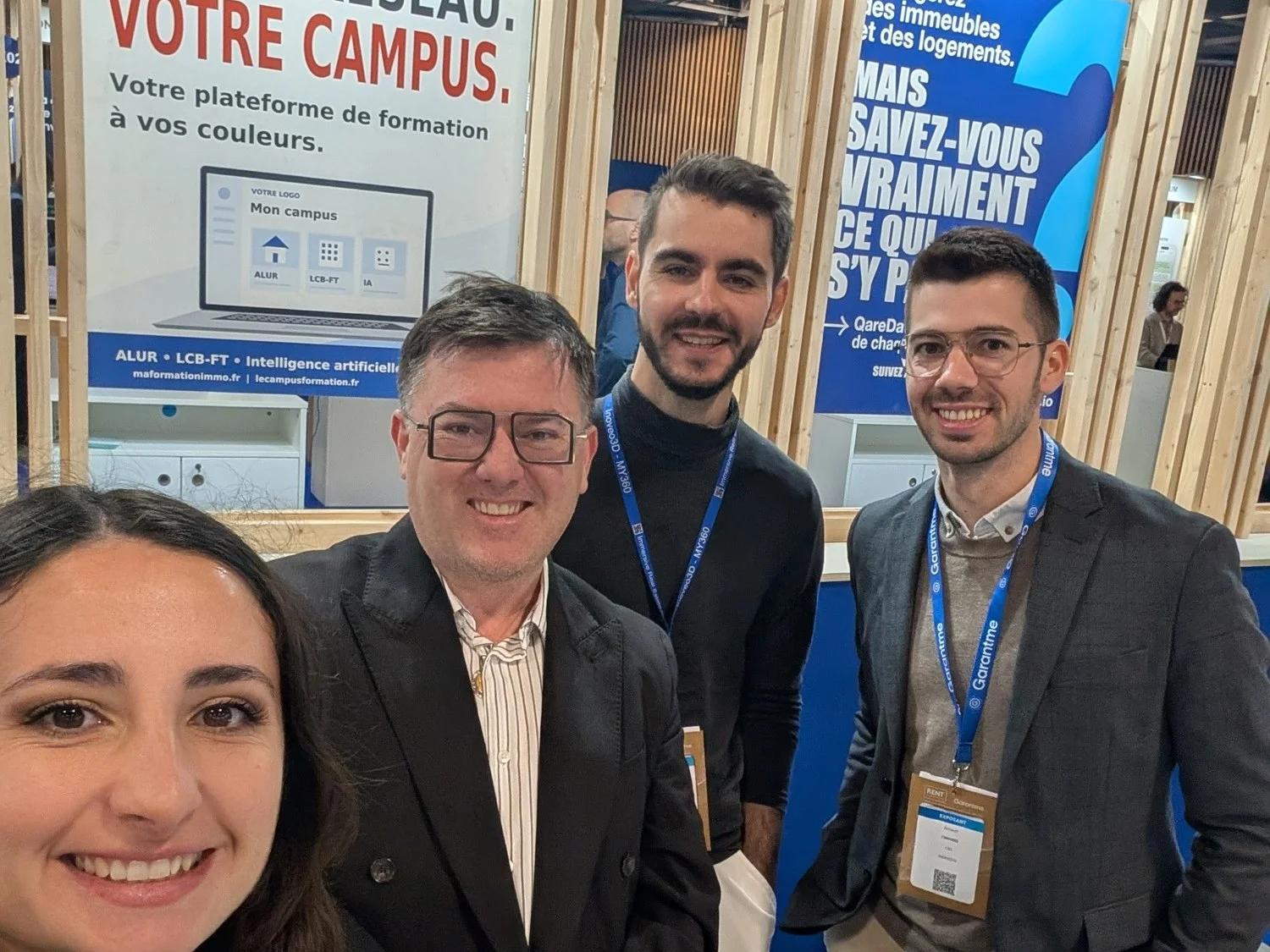
The Inoveo3D team at its booth at the RENT 2026 trade show.
These two approaches seem complementary to me.
We discussed several ideas around a possible partnership between training and technology solutions.
Nothing has been decided yet, but I think this kind of collaboration is worth exploring.
Five questions for Arnaud Convers, founder of Inoveo3D
To carry this conversation further, I put five questions to Arnaud Convers.
1 - What gave you the idea to create Inoveo3D, and what problem were you initially trying to solve for real estate professionals?
It started with a simple observation: a listing is won or lost on its first images, and a lot of properties are poorly presented — empty, dated, or hard to picture. The tools to fix that already existed, but they were complex, expensive, or reserved for specialists. We wanted to make this technology simple, usable by an agent in a few clicks, with no technical skills required.
2 - You're now building a white-label approach. How can real estate networks actually integrate your tools into their existing platforms, and what do they gain from it?
Our tools integrate directly into the network's own platform, under its name and its colours. For the agent, it's simply their network's tool — they never leave their work environment. On our end, we handle support, updates and new features as they roll out. The network can then offer modern tools without becoming a software publisher, and it keeps its people inside its own ecosystem instead of watching them equip themselves elsewhere.
Watch Inoveo3D's white-label offer in video (37s).
3 - Among your AI home staging, photo retouching, video generation and virtual tour solutions, which are used the most?
Virtual home staging and object removal are used the most, followed by floor, wall and sky retouching. And on 13 November we're launching 2D-to-3D Floor Plan: starting from a simple floor plan, the agent gets an already-furnished 3D model they can tour, customise and download. It was the number-one request at our RENT booth.
4 - How do you see artificial intelligence evolving in real estate agencies over the next three to five years?
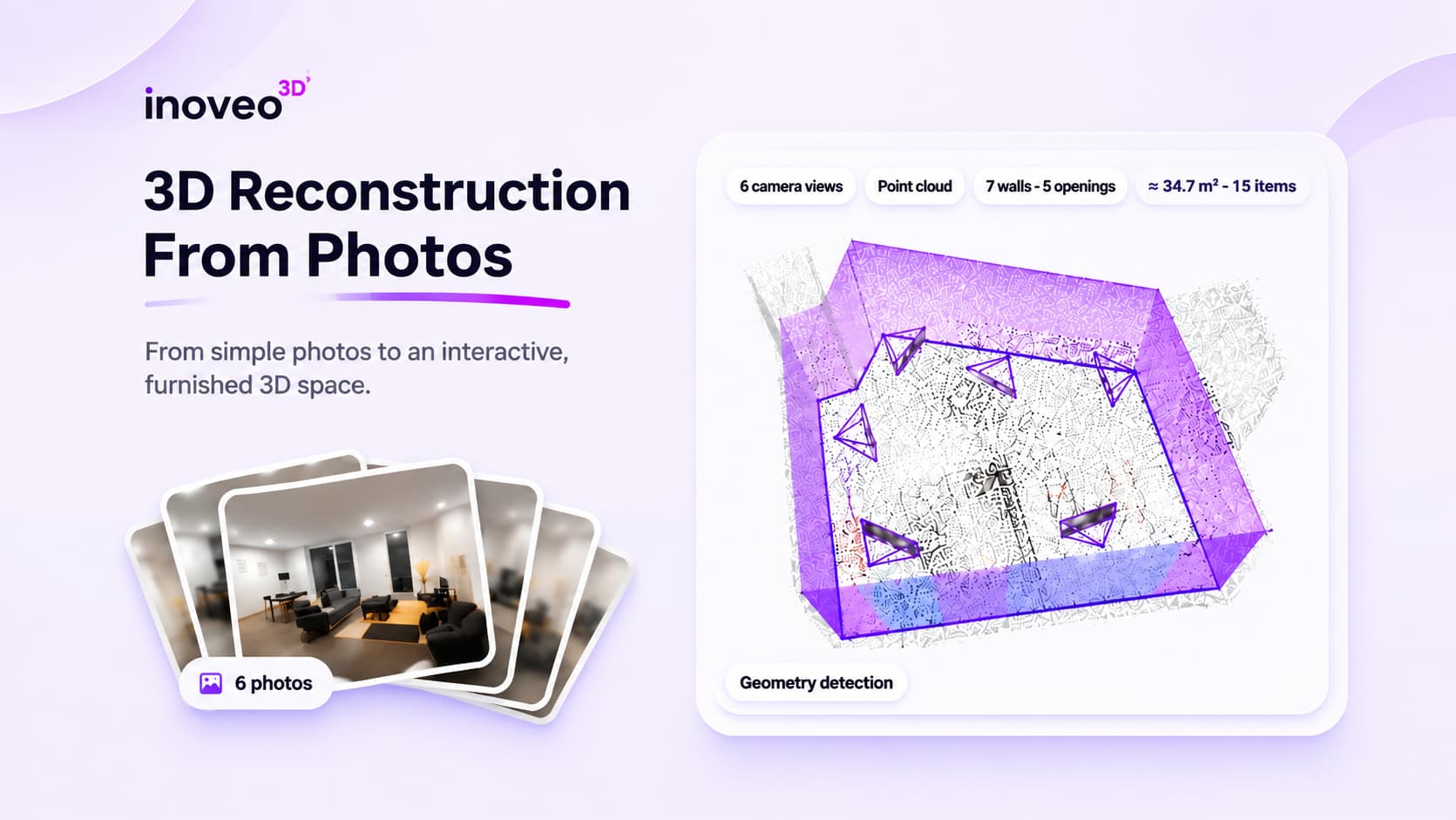
AI will first save time on repetitive work: preparing visuals, writing copy, formatting a listing. But I think the biggest impact will come from 3D: understanding a property without visiting it, picturing yourself in a home that's empty or not yet built. We've been working on this for two years in R&D, reconstructing a room in 3D from simple photos; a demonstrator was shown at RENT. And I agree with Julien: a virtually staged image must always be flagged as such. AI should serve good advice, never mislead a buyer.
2D-to-3D Floor Plan: from the plan to a furnished 3D model (launching 13 November).
5 - At RENT, we talked about Inoveo3D and MaFormationImmo working more closely together. How would you picture an offer combining our technology and our training paths?
A tool is only worth as much as agents actually know how to use it, and that's exactly what I liked about our conversation. I picture a network offering its staff, in one place and in its own colours, both the training and the way to put it into practice straight away: a module on showcasing a property, then the exercise directly on our tools, with real-world cases. Our two white-label approaches complement each other naturally. It's a direction I'd genuinely like to explore with Julien.
My conviction: the future belongs to useful, accessible ecosystems
In the coming years, real estate players will need high-performing technology, but also solutions that are simple to deploy and backed by proper training.
I'm convinced the sector's digital transformation will happen through more integrated environments, able to bring together tools, educational content and professionals' real needs.
The meeting with Inoveo3D illustrates that dynamic.
What if the next step for AI in real estate were precisely about bringing technology and skills closer together?
---
Julien Tabore
President of MaFormationImmo · www.maformationimmo.fr
Inoveo3D · inoveo3d.com
Inoveo3D's white-label offer in video
JT
Julien Tabore
President of MaFormationImmo
MaFormationImmo trains real estate professionals and builds white-label training Campuses for real estate networks.
We use functional cookies (necessary for the site to work) and analytics cookies (Vercel Analytics) to improve our service. Analytics cookies are anonymous and do not require your consent per CNIL guidelines, but you can still refuse them. Learn more