What exactly do real estate agent fees cover?
In practice, "commission" and "fees" are used interchangeably. This is the agency's (or sales agent's) compensation when the sale is completed.
These fees generally cover a range of services, which can vary from one agency to another: price estimation, listing publication, buyer qualification, visit organization, negotiation, file preparation, follow-up through to signing the preliminary contract and then the deed.
Important point: fees must be displayed transparently (in the window, on the website, and in listings), with a fee schedule. In France, the obligation to display and inform about prices is a key principle of consumer law.
Who pays the real estate agent fees, seller or buyer?
It's the mandate (contract between the agency and its client) and the listing that determine who the fees are charged to.
You'll often see:
• Net seller price: the amount the seller wishes to receive (excluding fees)
• FAI price ("agency fees included"): the price displayed to the public, including fees
• Fees charged to the buyer: the buyer pays the fees (they are added to the net seller price to form the FAI price)
• Fees charged to the seller: the seller pays the fees (they are included in the displayed price)
Impact on "notary fees" (duties and fees)
An often underestimated point: the calculation basis. When fees are indicated as "charged to the buyer" and separate from the net seller price, transfer duties (often called "notary fees") apply in principle to the net seller price, not to the "fees" portion.
This can slightly reduce the total amount of fees on the buyer's side. In practice, this can represent savings of several hundred euros, sometimes more depending on the fee amount and the nature of the property.
Fee structures: how are they set?
Free but transparency-regulated fees
In France, agencies freely set their fees. There is no mandatory national fee schedule. However, the agency must:
• Display a clear fee schedule
• Specify, in the listing, who bears the fees
• Indicate the fee amount in euros and/or as a percentage as applicable
Most common ranges
In practice, real estate agent fees observed in the residential market are often between 3% and 8% of the sale price, with variations depending on:
• The area (market tension, agency competition)
• The type of property (standard vs. atypical)
• The service level (photo, video, qualified visits, legal support)
• The price (fee schedules are frequently degressive)
Some agencies also work on a flat fee basis (example: €6,000), or with a hybrid model (flat fee + percentage above a threshold).
Example fee schedule (illustrative)
Actual fee schedules vary, but here's a fictional example to understand the degressive logic:
Up to €100,000: Flat fee of €6,000
€100,001 to €200,000: 6% of price
€200,001 to €400,000: 5% of price
Above €400,000: 4% of price
The purpose of this example is not to "give the right price," but to help you spot if an offer is coherent: a flat fee can be competitive on an expensive property, and conversely very heavy on a small budget.
Calculating the real cost: 3 common situations
Situation 1: Fees charged to the buyer
• Net seller: €240,000
• Fees: €10,000
• FAI price: €250,000
The buyer pays €250,000 in total, but the calculation basis for acquisition fees may be closer to the net seller price if the fees are clearly identified as "buyer charged."
Situation 2: Fees charged to the seller
• Displayed price: €250,000 FAI
• Fees: €10,000
• Net seller: €240,000
The seller "pays" the fees through the sale price, the buyer finances the total price (often through their loan).
Situation 3: Agency flat fee
• Net seller: €240,000
• Agency flat fee: €6,000
• FAI price: €246,000
The flat fee is simple to understand, but compare it to the value of the service provided. On a €120,000 property, a €6,000 flat fee already represents 5%.
Negotiation: how to negotiate fees intelligently
Negotiate, yes, but intelligently. Fees are not just an "extra cost," they fund work that can save time, secure the transaction, and sometimes improve the net seller price.
When negotiation is most likely to succeed:
• Easy-to-sell property (sought-after location, tight market, high demand)
• High price (agencies are sometimes more flexible on large amounts)
• Exclusive mandate (you offer commercial security to the agency)
• Competition (multiple agencies, or credible alternative)
Conversely, on a difficult property (major work needed, low EPC rating, slow market), the agency may refuse a reduction that would jeopardize their profitability.
How to negotiate concretely
You'll get better results by negotiating "like a professional buyer": based on scope, value, and commitment.
• Ask what's included: photos, video, floor plan, home staging, premium distribution, filtered visits, contract support
• Propose an exchange: fee reduction in exchange for exclusive mandate, or for a more realistic listing price
• Negotiate a schedule rather than a figure: for example, a different rate if the property sells in less than X weeks
• Confirm in writing: any modification must appear in the mandate or an addendum
A simple rule for arbitration:
If the agency helps you gain 2% on the final price (better pricing strategy, better presentation, better negotiation) while charging 5%, the operation isn't necessarily bad. The question is: does the agency have a method and proof of performance suited to your property?
Common pitfalls to avoid
1) Confusing "FAI" and "net seller" in negotiation
Many tensions arise from a misunderstanding: the seller thinks in "net seller," the buyer thinks in total "FAI" budget. Before making an offer or accepting a negotiation, lay out in black and white: net seller, fees, FAI price, and who pays what.
2) Comparing rates without comparing service
Two agencies at 4.5% can offer very different quality levels. The "cheapest" can cost more if the property stays on the market, gets stale (listing seen and re-seen), and ends up discounted.
Check before signing: visual quality, distribution strategy, ability to qualify contacts, visit reporting, and support through to the deed.
3) Not reading key mandate clauses
Focus on: mandate duration and termination conditions, exclusivity (and what it implies), compensation conditions (when commission is due), any additional fees (to be justified and framed).
Other common pitfalls
4) Unclear "additional fees"
A serious agency clearly announces its fee schedule. Be wary if you're charged vague fees (file, advertising, "introduction") without clear contractual justification.
5) The promise of a price too high to "win" the mandate
This is a classic trap: an overly ambitious starting price can multiply poorly qualified visits, extend delays, and lead to progressive price reductions that weaken your position. Result: you lose time and sometimes money.
A good mandate starts with an argued estimate (comparables, local dynamics, property condition, EPC constraints, work needed, etc.).
For agents: justifying fees through proof
On the professional side, pressure on fees increases as soon as the client perceives the agency as a simple "listing broadcaster." The best defense is to demonstrate measurable value: lead quality, reduction of unnecessary visits, sale times, and consistency between promise and result.
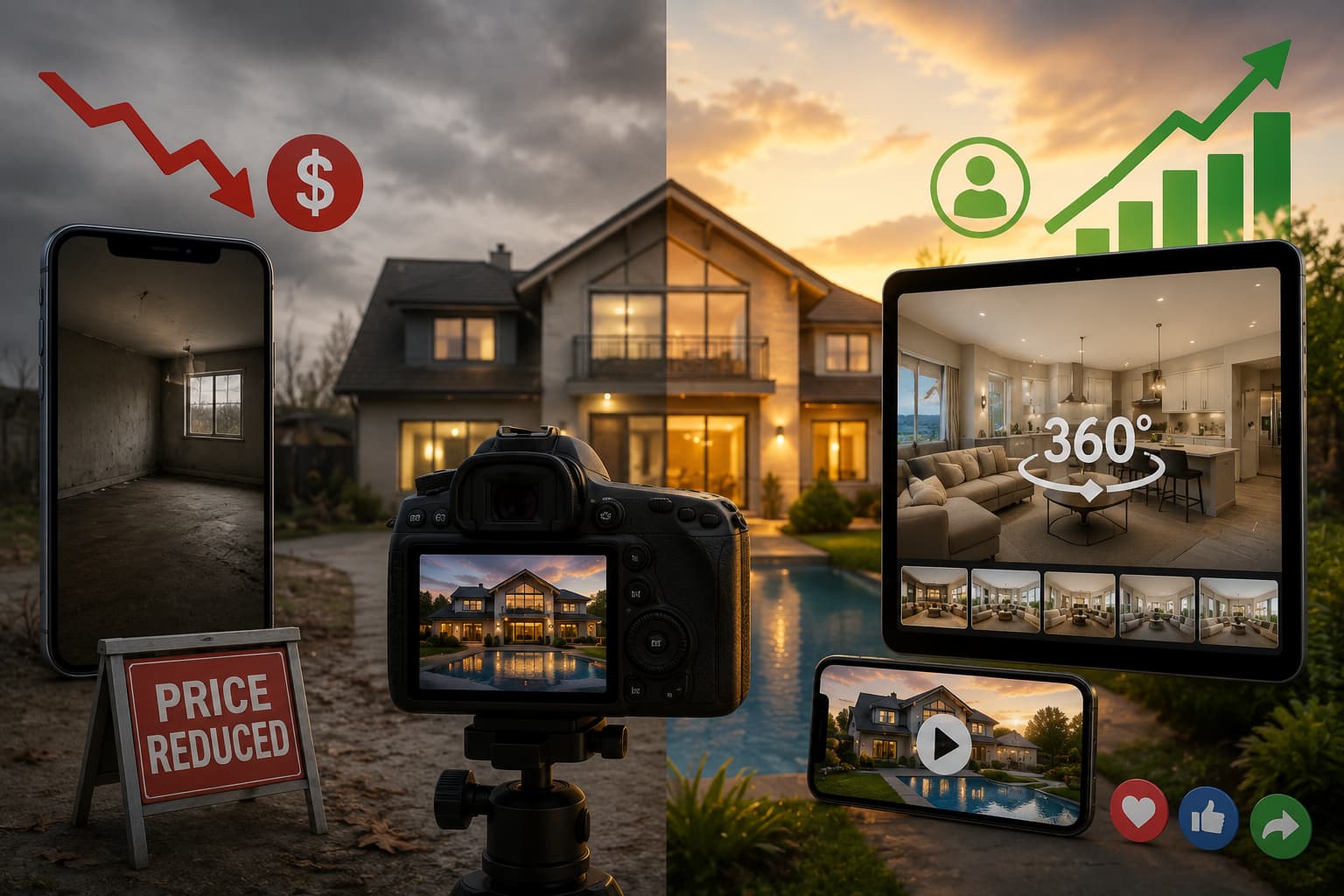
Presentation enhancement is often the most concrete lever, because it's immediately visible. Immersive and shareable formats (360° virtual tour, short video, virtual home staging) can help to:
• Capture attention faster on portals and social networks
• Improve understanding of volume and flow
• Filter prospects (less "tourism," more useful visits)
In this logic, tools like those from Inoveo3D (360° virtual tours, AI-assisted virtual home staging, video generation) are designed to produce more impactful content, also adapted to social media formats.
What really reassures sellers
"Why pay X%?"
What reassures: a visible marketing method
Useful proof: listing comparisons, visual quality, distribution plan
"I want to avoid unnecessary visits"
What reassures: pre-qualification and clear content
Useful proof: 360° virtual tour, presentation video, structured information
"I want to sell at the best price"
What reassures: a price + negotiation strategy
Useful proof: market analysis, visit reports, justification of adjustments
In summary: the right approach to paying the fair price
Real estate agent fees are not just a percentage. To decide with peace of mind:
• Identify who pays (seller or buyer) and verify net seller vs FAI consistency
• Compare offers on the same service scope, not just on the rate
• Negotiate in exchange for a commitment (exclusivity, realistic price, deadline)
• Secure everything in writing in the mandate (or an addendum)
A smooth and well-prepared transaction often costs less than a long sale, poorly presented, and renegotiated along the way.